
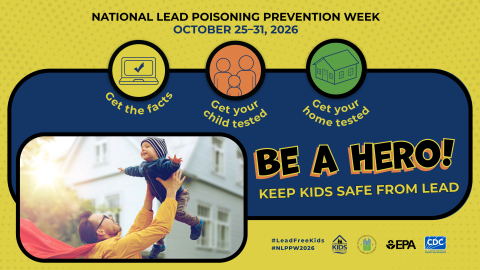
National Lead Poisoning Prevention Week, October 25–31, 2026, provides an opportunity to reduce childhood exposure to lead by raising awareness about lead exposure and poisoning, risk factors, and Michigan’s universal blood lead testing law.
This year’s theme is “Keep Kids Safe from Lead,” and the three key messages are:
- Get the Facts: Learn about lead hazards in your environment.
- Get Your Child Tested: Ensure early detection through a blood lead test.
- Get Your Home Tested: Identify and address potential lead sources.
Lead is harmful, especially for young children and pregnant women. Exposure to lead most commonly occurs from swallowing or breathing lead. Certain populations are at higher risk for lead exposure:
- People who live in homes built before 1978, especially children.
- People with pica.
- People who have jobs or hobbies working with lead.
- People who live in homes that may have one of the following:
- Lead or galvanized plumbing.
- A lead service line carrying water from the street to their residence.
- Old faucets and fittings that were sold before 2014.
The only way to know if a person has had recent or ongoing exposure to lead is to get a blood lead test. Children younger than six years of age are most vulnerable to lead poisoning, and exposure to even small amounts of lead can be harmful. Lead can affect several body systems, including the brain, nervous system and reproductive system, and may result in developmental and growth delays, hearing and speech problems, difficulty learning, reduced attention span, serious illness, and death.
To help prevent and address lead exposure in Michigan children as soon as possible, Public Acts 145 and 146 of 2023 established universal blood lead testing requirements. Physicians are required to provide or order blood lead testing for all children at 12 months and 24 months and at other intervals based on selected lead exposure risk factors. The legislation updated the Public Health Code by adding MCL 333.5474d and amending MCL 333.9206(1). Administrative rules (R 330.301–304) became effective April 30, 2025, implementing the requirements. For more details, review the Michigan Department of Health and Human Services’ (MDHHS) Universal Blood Lead Testing: Questions and Answers for Physicians.
MDHHS has assembled a variety of resources for the public, as well as for physicians and providers. Public resources include information on reducing lead exposure by implementing basic safety protocols such as washing children’s hands and toys often with soap and water, best practices for making childproof home improvements, and testing homes for lead. Physicians can access information on universal blood lead testing requirements, elevated blood lead levels, and data tracking.
If you have questions, please feel free to contact Stacey Hettiger, MSMS Senior Director of Advocacy and Payor Relations, at shettiger@msms.org or 517-336-5766.
Resources for the Public
- Mi Lead Safe
- Get Ahead of Lead
- Blood Lead Testing
- Universal Blood Lead Testing: Questions and Answers for Parents, Caregivers and the Public
- Lead and Your Health
- How to Find Out if You Have a Service Line Made of Lead
- Lead Plumbing Checklist
- Adult Exposure to Lead
- Is Your Child Safe from Lead Poisoning?
- Know the Facts About Lead
- Serve Up a Healthier Future
- Pregnant and Breastfeeding Persons
- Take Home Lead
- What You Should Know About Lead Paint Bookmark
- Lead Safety Tips Bookmark
- Universal Testing Factsheet
- What Your Child's Fingertip Blood Lead Test Means
Resources for Physicians and Providers
- Universal Blood Lead Testing: Questions and Answers for Physicians
- For Health Care Professionals
- MDHHS Quick Reference Guide for Providers
- Pediatric Blood Lead Level Guidance for Healthcare Providers
- Brochure Guide for Providers Applying Universal Testing Laws to Practice
- Childhood Lead Poisoning Prevention (CLPPP) Learning Module - CE Available
- MDHHS CLPPP Policy on Definition of Elevated Blood Lead Test Result
- MDHHS MiTracking - Michigan Environmental Public Health Tracking
Other Resources