
by Rachel Louise Just | Sinclair Broadcast Group
- Health_Medical_Pharma
- Michigan State Medical Society
- Michigan,United States
- Sidney Martin
- Bobby Mukkamala
- American Society Of Anesthesiologists
- Anesthesia
- Anesthesia Provision In The United States
topics:
LANSING, Mich. — New legislation going through the Michigan House would no longer require physician anesthesiologists to be present when a certified registered nurse anesthetist, or CRNA, administered anesthesia.
Michigan lawmakers on both sides of the aisle came together to co-sponsor House Bill 4359, but there has been less consensus across the medical community. Dr. Sidney Martin, who testified in front of the House Committee on Health Policy on March 3, 2021, in support of the bill, said the requirement that a CRNA be monitored by physicians was unnecessary.
“I do not want to supervise CRNAs. They are competent, safe, knowledgeable, licensed, insured professionals and patients gain nothing from having me or any other physicians supervise a CRNA,” said Martin.
He later added that he fully trusts the CRNAs he works with and "can think of no reason they should not be able to practice to the full extent of their current license.”
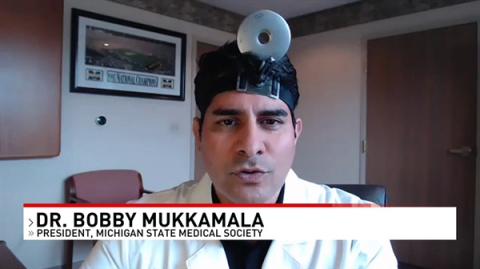
Not all members of the medical community agree. The American Society of Anesthesiologists advocated for physician supervision of nurses administering anesthesia and Dr. Bobby Mukkamala, a Flint-area otolaryngologist and president of the Michigan State Medical Society, has spoken out against the legislation.
“[Anesthesiology is] a very intimate role that leaves no room for error, which is why I strongly oppose HB 4359,” he said.
Physicians normally have at least 12,000 hours of patient care in their training, while CRNAs have 1,650, according to the American Association of Nurse Anesthetists.
Mukkamala, who stated he has 20 years of experience in surgery, said there are unexpected fatalities associated with not having the most highly-qualified person in the room.
“There’s data available to show that patients are at higher risk when there is no physician around to assist in their anesthesia care,” he said.
Supporters of the bill called out the rhetoric used by those, like Mukkamala, who are opposed to the legislation.
“Only in very rare circumstances, such as for diagnostic tests, are CRNAs providing anesthesia services without the service being associated with a procedure,” said Martin.
Some supporters argued the rule made procedures more costly. Physician anesthesiologists are expensive, costing hospitals about three times what they'd spend on a CRNA, according to the American Association of Nurse Anesthetists.
Mukkamala, however, pushed back on that argument.
“Under Medicare, Medicaid, and most insurance plans, the fees for CRNA-provided anesthesia and physician care are the same,” he said, adding that "there’s plenty of research to show that when CRNAs are the sole decision makers for anesthesia care, cancellation surgery and testing ordered both go up, which of course means costs go up, not down.”
No final votes were taken on the bill by the end of session on Tuesday.