
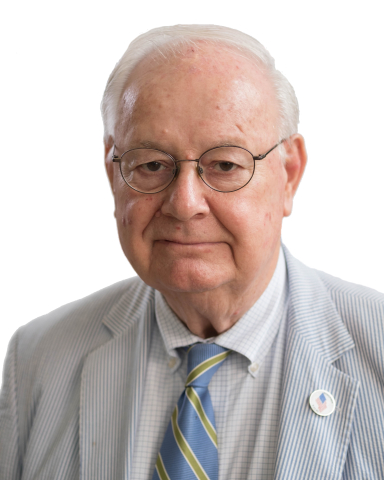
The Michigan State Medical Society (MSMS) regrets to share the recent passing of John J.H. Schwarz, MD. Doctor Schwarz was a long-time member, former Board member, Presidential Citation recipient and mentor to many. In honor of his long career in medicine and public service, MSMS is sharing one of many tributes published in state media over the last few days. MSMS extends our sincerest condolences to the Schwarz family.
Joe Schwarz, 88, Remembered as Statesman, Champion of Higher Ed
Reprinted with permission from Gongwer News Service Michigan.
Article by Zach Gorchow.
Combat surgeon. Naval attaché. Employee of the Central Intelligence Agency. Community otolaryngologist. Battle Creek mayor. State senator. Orator. Congressman. University lecturer. Joe Schwarz was all of those things during his life, but one word surfaced more than any other Wednesday as news spread of his death at 88.
Statesman
Schwarz was a singular presence during his 16 years in the Senate from 1987-2003, when term limits forced his exit.
He was brilliant and understood the finer points of legislating to a degree few others have matched. His erudite nature meant he could turn a phrase to great effect. He was an unrivaled champion of the need to fund the state's public universities and used his perch as chair of the Senate Appropriations Higher Education Subcommittee to leverage funding increases. His knowledge of healthcare meant he could bring expertise to policy and Appropriations unlike most others.
For all his successes at the Capitol and unique presence in the Capitol community, however, Schwarz always held his service to his community of Battle Creek and environs as an ear, nose and throat physician high above his work as an elected official. And his approach to politics was often apolitical.
"Getting elected isn't the be-all and the end-all, but telling the truth is," Schwarz once told the editorial board of the Observer & Eccentric newspapers during an unsuccessful run for governor. Schwarz remained a significant presence long after leaving the Senate.
In 2004, he won a memorable race for a U.S. House seat in south-central Michigan. A decidedly Republican seat, Schwarz's centrist approach carved a lane for him in a primary with five well-known conservatives, and he won with 28% of the vote. Tim Walberg, who finished third in that year's primary, would oust Schwarz in 2006 in a one-on-one race in which conservatives rallied behind Walberg.
In 2007, then-Defense Secretary Robert Gates named Schwarz to a panel reviewing military hospitals. He was the chair of the successful 2008 constitutional amendment to authorize embryonic stem cell research in Michigan.
A Republican all his life, Schwarz left the party in 2010 to become an independent and even briefly ran for governor as a candidate without party affiliation. He quickly dropped the effort after concluding it was not possible to raise the funds necessary. He later supported the Republican nominee, Rick Snyder, for governor, noting Snyder's support for the stem cell ballot proposal.
Democrats tried to convince Schwarz to join their party and run for Congress in 2004 and 2012, but he declined. "Democrats have approached me many times. I'm complimented that they think I'm someone they could support, but I'm a Republican," Schwarz said in a 2004 interview. "I'm a brand of Republican I hope will not die out."
He would support the redistricting ballot proposal in 2018 and backed Gov. Gretchen Whitmer for governor that same year over his onetime state Senate colleague, Bill D. Schuette.
"Today, Michigan lost a leader and a hero, Dr. Joe Schwarz. Joe was not only a mentor but a friend," Whitmer said in a statement. "A proud Wolverine, he offered rivalry on game days and laughed on tough days. He led a life of service and embodied everything that makes our state so special. He was a reminder that we can sit on different sides of the aisle – and even cheer for opposing teams – yet still find common ground serving the people of Michigan. As a physician, a professor, and a representative, Joe led a life that put people first. My condolences go out to his family and loved ones. Joe will be dearly missed."
From Battle Creek to Jakarta and back
Born in Chicago, John J.H. "Joe" Schwarz's family moved to Battle Creek, where he graduated high school. In 1999, when Kellogg announced a significant restructuring with jobs cuts at its Battle Creek operations, an outraged Schwarz recalled that as a boy, he had shaken the hands of both John Harvey Kellogg, who founded the famous sanitarium in Battle Creek, and W.K. Kellogg, who took the process for making corn flakes and commercialized it.
Schwarz earned his bachelor's degree from the University of Michigan (where he played center and linebacker for the football team) and his doctor of medicine from Wayne State University, the latter in 1964.
Soon thereafter, he would deploy to Vietnam with the U.S. Navy as a combat medic, later becoming assistant naval attaché at the U.S. embassy in Jakarta. He would then serve three years in the CIA before returning to Battle Creek to practice otolaryngology. Schwarz's CIA activities were a secret for most of his life. The agency recruited him to join, and he went to Laos and eventually Thailand.
Schwarz also got into politics. He was elected to the Michigan Republican State Committee for a term in 1975-76 and then the Battle Creek City Commission in 1979. For an interview with the U-M Gerald R. Ford School of Public Policy, Schwarz was asked why he ran for office. He said it fell into place after returning to Battle Creek following completion of his medical residency at Harvard University.
"The roads have to be paved," he said. "The sewage system has to work. The water system has to work. The bridges have got to be OK. The police and fire have got to be top notch. These are exclusively the function of local government. Cities like Battle Creek, and Jackson, and Kalamazoo, and Midland, and Bay City, and Saginaw, and Flint need local leadership. And people have got to step forward."
In 1984, Schwarz was elected Battle Creek mayor. Then he made his move to run for state office in 1986. The area's Senate seat was open. Schwarz faced then-Rep. Ernie Nash and one other candidate in the Republican primary. He won decisively and never faced a serious threat to reelection in the Senate again for a district that generally consisted of Calhoun and Eaton counties.
The Senate years
Once in the Senate, Schwarz found a kindred spirit in its Appropriations chair, Sen. Harry Gast. For as much as Schwarz through the years would grumble about politics too often trumping what was best for the state, he proved adept at political mechanics and the rules. He was named to the Appropriations Committee. In 1994, when the president pro tem of the Senate, Vern Ehlers, vacated his seat to join Congress, Schwarz won a hotly contested race in the Republican caucus to replace him.
His opponent in that race, Jack Welborn, memorably said afterward he had assurances from 13 of the 21 Republican members they would support him and was shocked to see Schwarz win.
Schwarz also knew how to work with Democrats to achieve his goals. His counterpart on higher education appropriations in the House for many years was Rep. Morris Hood Jr., a giant in his own right, and the two teamed up to boost funding for higher education.
Schwarz didn't suffer fools, and he didn't hold back. In the late 1990s, the state shifted its Medicaid system from fee for service to managed care, and the transition proved controversial. A Senate subcommittee conducted several hearings, and Schwarz lamented that the move to managed care was "like shoving 10 pounds of shit into a five pound bag."
In his final term, Schwarz had some huge battles with House Republicans as a new generation of Republicans arrived under term limits. House Republicans sought to boost funding to universities that historically received less per student. Schwarz didn't much care for that approach, and there was an incredible exchange of at times vicious floor speeches between himself and then-Speaker Chuck Perricone about the higher education budget.
Schwarz's higher ed appropriations counterpart in the House, Rep. Sandy Caul, was a nurse and needed Schwarz so that doctors would listen to nurses more often. Still, the overall university budget protected Schwarz's priorities.
Rebecca Schneider, who was Schwarz's Senate chief of staff for several years and then district director when he served in the U.S. House said Schwarz was most proud of his efforts to robustly fund higher education.
Schneider recalled going with Schwarz on the road to visit all 15 public universities and Schwarz's belief that people could pull themselves into a better economic situation through higher education.
"I think he loved the idea of learning," she said. "He even told my daughter, who is now at LSA at U of M, what a wonderland that was for him." Matt McLogan, who spent decades in and around state government, including a long run as the head of government affairs for Grand Valley State University, said he considers Schwarz the most impactful member of the Michigan Senate in his adult life and cited his commitment to higher education.
"Nowhere was his impact felt as keenly as in higher education. Joe was deeply committed to it as a public good – and necessity. His support for it never wavered. Even in tough times, when budgets were being cut, he fought to minimize the impact on our universities," he said. "His hallmarks were consistently good judgment and a first-class temperament. These characteristics enabled him to understand and anticipate the impact of policy decisions over time."
The Hood-Schwarz tandem was improbable in some ways. They had both spent time in the military, and they both spent time at Wayne State. Beyond that, the two didn't have a ton in common. Hood railed at U-M for not accepting more Michigan residents. Schwarz wore Maize and Blue on his sleeve. But they both agreed Michigan's colleges and universities were one of the state's best resources and should be adequately funded.
"The mutual respect we held for each other enabled us to resolve differences amicably," Schwarz said in a post-career interview. Schneider recalled the two, when negotiating the higher education budget, would eventually kick out the staff. They would split a six-pack of beer. Yelling could at times be heard. But they would eventually get a deal done and become friends. It was in 2001 when perhaps Schwarz's full array of life experience was on display. Sen. Mat Dunaskiss was about to give a speech on the Senate floor when he suddenly collapsed.
Schwarz, seated at the back of the chamber, rushed to the front, shouting at people to get out of his way and tore off his suit coat as he knelt beside Dunaskiss, who had stopped breathing. He began performing CPR, and Dunaskiss began breathing on his own again, surviving the ordeal. The next day, Schwarz received a standing ovation in the Senate for his efforts.
As he left the Senate in 2002, his farewell remarks sounded a note of fatigue with politics.
"Some days it was a privilege, and other days it was a weird burden to come up here from Battle Creek from my medical practice," he said. "Some days this chamber was brilliant, and other days this chamber is a zany irrelevance. You take your choice. Some days I think we – including myself – are a bunch of vapid dilettantes who never miss an opportunity. Other days we do much better."
He used Latin several times and said to the body, "Caeser si viveret omnium ad renum dareis – if Caesar were alive, you all would be chained to an ore." Schwarz may have sounded fatigued with politics in 2002, but he was a natural at it. He understood the process and how to build coalitions.
Schneider said Schwarz could play the game at the same level as Gov. John Engler, who was Schwarz's first Senate majority leader. "He could see things and maneuver things and have ideas about how things were going to work before most people could see them," she said. "He was good at it. I don't know where he got the strategic part of that down, but gosh he really had it down. He would call me on the way to Battle Creek and say 'draft an amendment to do something' and I wouldn't even know what it was about."
Some political successes, setbacks
Schwarz was instrumental in one of the great upsets in Michigan political history. Going into the 2000 presidential campaign, then-Gov. John Engler lined up virtually the entire Republican establishment and operation behind Texas Gov. George W. Bush.
Schwarz was one of the few not to join the Bush parade, instead siding with his fellow Vietnam veteran and the more centrist Sen. John McCain. Few believed McCain had a chance going into the state's presidential primary. But McCain topped Bush in a landslide.
When the Senate convened the following morning, most Senate Republicans were smarting from the loss but also gave Schwarz his flowers. As the session opened, then-Majority Floor Leader Mike Rogers moved "that the senator from 24th District wipe the smile from his face." Schwarz, the senator from the 24th District, objected to the motion. Schwarz said he was not surprised McCain won, saying McCain connected with people everywhere and that a rally in Traverse City was "almost a religious experience."
In 2002, Schwarz ran for governor, facing off against his onetime Senate colleague, Lt. Gov. Dick Posthumus, in the Republican primary. But Schwarz, a centrist Republican, was out of step with the Republican electorate, and Posthumus won easily.
His 2004 congressional victory was the stuff of legend. Schwarz went all-out for a district even more conservative than the statewide Republican electorate. Kismet was in his favor. Five conservatives – Brad Smith, son of the outgoing incumbent, state Reps. Clark Bisbee and Gene DeRossett and former state Reps. Paul DeWeese and Tim Walberg – split the conservative vote.
Smith finished second, ironic considering his father, Nick Smith, upset Schwarz when the two faced off for the same U.S. House seat in 1992. The 2006 loss to Walberg, who received considerable support from the Club for Growth, was a bitter pill for Schwarz and his team.
Schneider recalled a day campaigning on Walberg's home turf in Lenawee County. They were running late, hadn't eaten and were grouchy. Schwarz took a call from someone whose husband had been diagnosed with cancer.
"On a day when everything was going to hell in a hand basket, he spent time talking to that person in a way that only a person who had a spouse diagnosed with cancer could," she said.
Schwarz's first wife, Anne, died of cancer in 1990. Schwarz remained a beloved figure around Lansing long after he left elected office.
In 2017, in an interview with the U-M Ford School, Schwarz was asked what was next for him.
"I'll still practice medicine, and I'll do that 'til the day I die," he said. "I'm at Grace Health, a federally qualified health center. I went over there 20-plus years ago. I see patients who have insurance, I see patients on Medicare, I see patients on Medicaid, I see people who have nothing. I'll continue to perform a service in my community."