
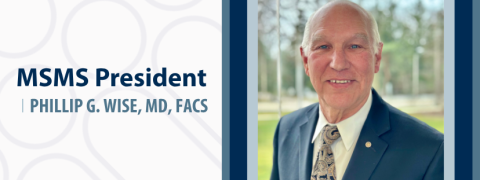
For Phillip G. Wise, MD, becoming President of the Michigan State Medical Society (MSMS) was never necessarily part of a carefully mapped-out career plan. Instead, it was the culmination of decades of saying yes—to opportunities, to leadership, and to organized medicine.
“I never really planned on doing all this stuff,” Doctor Wise said of his journey through medical society leadership. “But here I am, president of the MSMS.”
That journey has taken Doctor Wise across the country, and even across the Atlantic. Through nearly every level of organized medicine. As he begins his term as MSMS President, he brings with him a deep belief in physician advocacy, membership, grassroots engagement, and the power physicians have when they speak with a collective voice.
A Calling Rooted in Family
Medicine was part of Doctor Wise’s life from the beginning. His mother was a nurse who served as a Charge Nurse in the polio ward at Children’s Hospital in Los Angeles, where she cared for patients in iron lungs. His father, a recent graduate of the University of Southern California School of Medicine, met her while rotating through the hospital as an intern.
Growing up in Santa Monica, California, Doctor Wise found his own early connection to medicine as an Eagle Scout. For his Eagle Scout project, he worked in the Santa Monica emergency department, taking blood pressures, helping organize the department, and assisting wherever he could.
It helped confirm what he already suspected: medicine was where he belonged.
Doctor Wise earned his undergraduate degree in physics from the University of Southern California, where he also played water polo. His path to medical school, however, wasn't entirely conventional. After initially not being accepted, he worked as a sleep lab technician at Baylor College of Medicine. A chance encounter with a professor from Belgium led him to study medicine there before eventually transferring back to USC School of Medicine, where he completed his medical degree.
After discovering an interest in urology, Doctor Wise returned to Baylor College of Medicine, completing two years of general surgery, four years of urology training, and a fellowship in male infertility.
Finding a Home in Organized Medicine
Doctor Wise’s involvement in organized medicine began while practicing in San Diego. A colleague encouraged him to give a presentation at the California Medical Association, with one requirement: he had to become a member.
That simple invitation opened the door to decades of involvement.
He became active in local and state urological societies and the San Diego County Medical Society, eventually serving on its Board of Directors and moving toward its presidency. He also became involved with the California Medical Association’s Council on Legislation.
Then life changed course.
When Doctor Wise’s youngest child was diagnosed with autism, his family began searching for the right educational environment. That research ultimately brought them to West Michigan, where Doctor Wise essentially started over, both professionally and in organized medicine.
He joined the Kent County Medical Society and MSMS and became involved in legislative and regulatory work at both the county and state levels. From there, one opportunity seemed to lead naturally to another: committee leadership, Vice Speaker of the MSMS House of Delegates, Speaker of the House, President-Elect and, ultimately, President.
Throughout that journey, mentors encouraged him to keep stepping forward. Among the most influential was Domenic Federico, MD, who Doctor Wise credits with encouraging him and helping him understand the leadership path ahead.
“He was always encouraging me,” Doctor Wise said.
The Value of Organized Medicine
For Doctor Wise, organized medicine isn't simply about holding leadership positions. It is about giving physicians access to information, relationships and influence they often cannot achieve on their own.
His involvement at the local, state and national levels has given him insight into everything from reimbursement and relative value calculations to legislation and payer policies, knowledge he has been able to bring back to his own practice and colleagues.
It has also reinforced his belief that physicians need a strong collective voice, particularly as decisions made by lawmakers and payers increasingly affect how physicians practice medicine and care for their patients.
That belief will be central to his presidency.
Bringing MSMS Back to Physicians
One of Doctor Wise’s priorities is straightforward: get out and talk to physicians.
After learning that other state medical society presidents regularly travel throughout their states to engage directly with physicians, Doctor Wise asked MSMS staff whether Michigan could revive a similar tradition that had existed before the COVID-19 pandemic.
The answer was yes.
That conversation helped spark a renewed effort to take MSMS leadership on the road, giving physicians across Michigan opportunities to hear directly from the Society, learn what MSMS is working on, and equally important tell leadership what they are experiencing in their own communities.
“I think the president going out and talking to physicians across the state is very important,” Doctor Wise said.
It reflects the kind of leadership he hopes to bring to the presidency: accessible, engaged and connected to physicians where they live and practice.
Advocacy and Membership: Two Priorities for the Year Ahead
When asked about the greatest opportunities facing MSMS and organized medicine, Doctor Wise returned repeatedly to two themes: advocacy and membership.
He believes one of MSMS's most important responsibilities is maintaining a strong presence in Lansing and helping policymakers understand how legislation affects physicians, their practices, and ultimately their patients.
“I think it's a matter of education,” he said, emphasizing the importance of educating legislators about the real-world consequences of policy decisions and helping influence thoughtful legislation.
But effective advocacy requires a strong membership base.
“Without membership, you don't have the resources… to get things done that you need to have done at the level of Lansing,” he said.
Growing membership, therefore, isn't simply about increasing numbers. To Doctor Wise, it is directly connected to MSMS's ability to represent physicians effectively.
He also sees physician workforce challenges as an important issue for organized medicine, particularly the need to attract and retain physicians in Michigan. Drawing from his own specialty of urology, he pointed to longstanding limits on training positions and the consequences those decisions continue to have on physician supply decades later.
Leadership Through Preparation, Participation and Respect
For physicians interested in becoming more involved with MSMS, Doctor Wise’s advice is refreshingly simple: start by showing up.
“Get involved, go join a committee,” he said.
He also encourages physicians to come prepared, understand the issues, share their opinions when they have something meaningful to contribute, and respect the time of everyone around the table.
It is an approach that mirrors his own leadership journey. Doctor Wise did not begin his career with the goal of becoming president of a state medical society. He joined. He participated. He accepted opportunities. He learned from mentors. And when someone asked him to step forward, more often than not, he did.
Beyond the White Coat
Away from medicine and organized medicine, Doctor Wise still finds ways to stay active.
A former Division I water polo player, he continues to enjoy swimming and even competed as part of a relay team in the Grand Haven Triathlon, completing the mile-long swim while teammates handled the cycling and running portions. The team finished first.
He also enjoys traveling and spending time outdoors at home, where he tends to his family's garden and koi pond.
Looking Ahead
As MSMS President, Doctor Wise hopes to strengthen the Society's presence in Lansing, grow membership, and build relationships with lawmakers and physicians throughout Michigan.
“I think we need to have quite the presence in Lansing,” he said. “And we've said it before, we need to have more people join.”
For someone who describes his path to the presidency as something that almost happened to him along the way, there is nevertheless a clear thread running through Doctor Wise’s career: a willingness to participate, to serve and to keep showing up.
Now, as President of MSMS, he hopes more Michigan physicians will do the same.
Because a stronger MSMS begins with engaged physicians, Doctor Wise intends to spend his presidency making sure they know their voice, their membership and their involvement matter.