
Michigan lawmakers are considering a flurry of legislation as the July 1 deadline to reach a state budget nears. This week saw committees advancing and reviewing a wide range of health policy legislation spanning workplace safety in clinical settings, maternal and infant health support programs, insurance market restructuring, Medicaid eligibility rules, and restrictions on certain medical treatments.
Workplace Violence Against Healthcare Workers
Michigan legislators are considering House Bills 4532, 4533, and 4534, a package aimed at addressing rising workplace violence in healthcare settings.
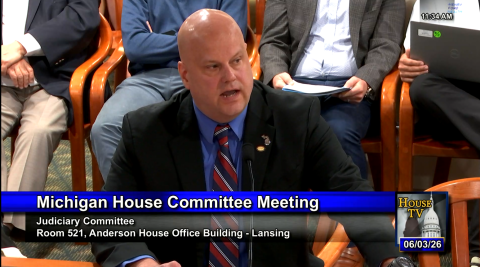
Testimony before the House Judiciary Committee from Michigan State Medical Society (MSMS) Board Chair Brad Uren, MD, underscored the severity of the issue, noting that approximately 40 percent of healthcare workers have considered leaving their jobs due to safety concerns. He emphasized that workplace violence has long-term consequences not only for staff but also for patient care delivery and system stability.
Supporters of the legislation cited alarming national and state-level trends, including data indicating that 91 percent of emergency physicians have experienced or witnessed an assault within the past three years. The bills would increase criminal penalties for assaults on healthcare workers and create an assisted outpatient treatment diversion program for certain individuals experiencing mental illness.
While proponents argued the measures would improve accountability and deter violence, some lawmakers raised concerns about creating profession-specific penalty enhancements and emphasized the need for broader prevention strategies in addition to criminal enforcement. The bills remain under committee review, with substitute language to address those concerns already in the works.
State-Based Health Insurance Exchange Proposal
The Senate Health Policy Committee heard testimony on Senate Bills 973, 974, 975, 976, 977, and 978, which would establish a state-based health insurance exchange in Michigan.
Supporters argued that creating a Michigan-run marketplace for individual health insurance coverage could improve enrollment outcomes, streamline consumer access to plans, and allow the state to retain user-fee revenue currently directed to the federal government for reinvestment in outreach and administrative functions.
Testimony included input from state officials, policy experts, insurance technology vendors, and brokers. Discussions centered on projected implementation costs, system design, enrollment impacts, and operational feasibility.
However, several Republican lawmakers expressed concern regarding startup expenses, cybersecurity risk, and Michigan’s historical challenges with large-scale IT system implementation. The committee did not take a vote, and further deliberation is expected.
Testimony on Pre-Admission Screenings for Behavioral Health
The House Health Policy Committee heard testimony on House Bill 6022, which would allow Medicaid health plans to conduct pre-admission screenings for behavioral health patients when those plans bear financial responsibility for care.
Supporters argued the measure could reduce emergency department delays and improve accountability by establishing a three-hour screening response requirement, with fallback options for hospitals or contracted entities if timelines are not met.
Opponents, including representatives from the Community Mental Health Association of Michigan, argued that existing screening processes already meet performance standards. They attributed emergency department bottlenecks more to systemic shortages of psychiatric beds and treatment resources than to screening delays.
The committee heard testimony from insurers, mental health providers, and patient advocates but did not advance the bill to a vote.
Medicaid Retroactive Coverage Changes
The House Insurance Committee reviewed House Bill 5814, which would align Michigan Medicaid policy with federal changes effective January 1, 2027, under broader implementation of federal health policy reforms.
Currently, Michigan Medicaid can provide retroactive coverage for eligible medical expenses incurred up to three months prior to application. The proposed changes would reduce that window to one month for Medicaid expansion populations and two months for traditional Medicaid enrollees.
While MSMS opposed the reductions in retroactive coverage due to concerns about access to care and uncompensated care costs, committee testimony acknowledged that the federal change is already enacted and states must comply. MSMS continues to oppose codifying the reduced standards into state law.
Rx Kids Program Oversight and Outcomes
The House Oversight Committee reviewed the state-supported maternal and infant health initiative known as the Rx Kids program.
Program administrators reported that Rx Kids has now served approximately 30,000 babies since its launch in Flint in 2024 and has expanded to additional communities across Michigan. The program provides direct cash assistance to pregnant individuals and new mothers.
Testimony highlighted research linking the program to improved prenatal care utilization and reductions in premature births, low birth weight incidence, neonatal intensive care admissions, postpartum depression, and infant mortality.
Committee members focused heavily on program governance and accountability, raising questions about funding structure, eligibility verification, fraud prevention, and long-term sustainability. Administrators responded that safeguards are in place to verify eligibility and ensure proper use of funds, with most financial assistance distributed directly to families.
No legislative action was taken.
Gender-Affirming Care Legislation Passes House
The Michigan House passed House Bills 4466, 4467, and 4468 on party-line votes. The legislation would prohibit certain gender-affirming medical treatments for minors and impose disciplinary consequences on healthcare professionals who provide prohibited services.
MSMS opposes legislative restrictions that intervene in clinical decision-making and the physician-patient relationship, arguing that such decisions should remain under medical professional judgment in consultation with patients and families and that sanctions should not be levied against physicians providing such care.
Despite House passage, the bills face a steep challenge in the Democrat-controlled Senate, where further consideration is considered unlikely in the current legislative term.
Conclusion
With 12 scheduled session days between now and when they are likely to break for the summer, legislators are pressed to advance their priorities. As attention shifts to the budget, fewer and fewer policy measures will be moving until the fall.
For further information on these and other issues, please contact MSMS Director of Government Affairs, Kate Dorsey, at kdorsey@msms.org.