Whether it’s advocating for legislation, addressing payment concerns with health plans and insurers, or making sure physicians are represented, the Michigan State Medical Society (MSMS) Advocacy team is working on your behalf. The following are some recent highlights:
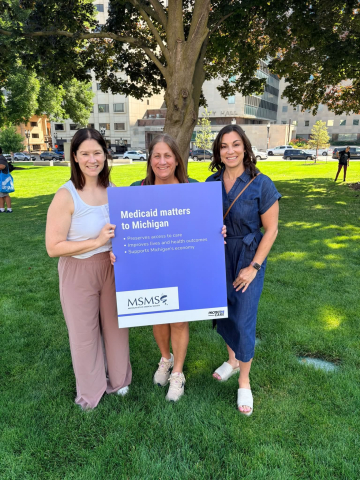
- Participated in the Protect MI Care Coalition’s March for Medicaid to celebrate the program’s 61st anniversary and value to Michigan's Medicaid recipients, as well as to make clear that Michiganders will not stand by while their coverage is cut. MSMS is a member of the Protect MI Care Coalition, an alliance of more than 275 healthcare providers, advocates, and community organizations.
- Signed on to joint letter with the American Medical Association and other state and national organizations urging that the Centers for Medicare and Medicaid Services (CMS) not to finalize the proposed policy to reduce payment by 50 percent when a separately identifiable office/outpatient (O/O) evaluation and management (E/M) service reported with modifier -25 is furnished on the same day as a procedure with a 0-, 10-, or 90-day global period.
- Created a template letter for physicians to use for submitting comments to CMS opposing the above-mentioned proposed modifier 25 policy, as well as a letter to send to federal legislators via the MSMS Grassroots Action Center.
- Met with the Executive Office of the Governor to discuss HB 5313 and urge support.
- Attended the Blue Cross Blue Shield of Michigan (BCBSM) joint meeting of the Participating Hospital Agreement and Professional Provider Relations Advisory Committees. BCBSM leadership provided updates and presentations focused on affordability and policy updates for the upcoming year.
- Facilitated a meeting with leadership from BCBSM and Physician Organizations to discuss concerns regarding the upcoming Incident-to billing policy changes.
- Welcomed Physician Organization member leaders for an in-person meeting focused on the policy, regulatory, and operational issues shaping health care in Michigan. The gathering provided an opportunity for attendees to hear directly from state and federal leaders, including Tanya Pagan Raggio-Ashley, MD, Regional Chief Medical Officer for the Center for Clinical Standards and Quality for Regions 1 and 2, and Brenda Delgado, External Affairs, Centers for Medicare & Medicaid Services.
- Encouraged support for the following bills at the federal level:
- Improving Seniors' Timely Access to Care Act (H.R. 3514 and S. 1816) which seeks to modernize the Medicare Advantage prior authorization process by establishing electronic prior authorization, strengthening transparency and accountability, increasing proper government oversight, and streamlining determinations for medically necessary care. Click here to urge Congress to pass the “Improving Seniors’ Timely Access to Care Act.”
- Patients First Act (H.R. 9693), a comprehensive proposal to reform the Medicare Access and CHIP Reauthorization Act (MACRA) and the Medicare physician payment system. If enacted, the bill is positioned to make a number of changes to positively impact access to care including a greater investment in primary care, an annual positive inflationary updates for Part B physician payment, and a higher threshold for triggering budget neutrality. Voice your support by sending an email to your U.S. Representatives.
- The Provider Reimbursement Stability Act (H.R. 8163 and S. 5180) which would modernize key budget neutrality rules, mandate that CMS evaluate the actual base costs for running a medical practice at least every five years, and revise how CMS addresses incorrect billing codes. Contact your U.S. Senators and urge them to support common sense Medicare payment reforms by cosponsoring this bipartisan bill.