How MSMS Resolutions Shape Policy
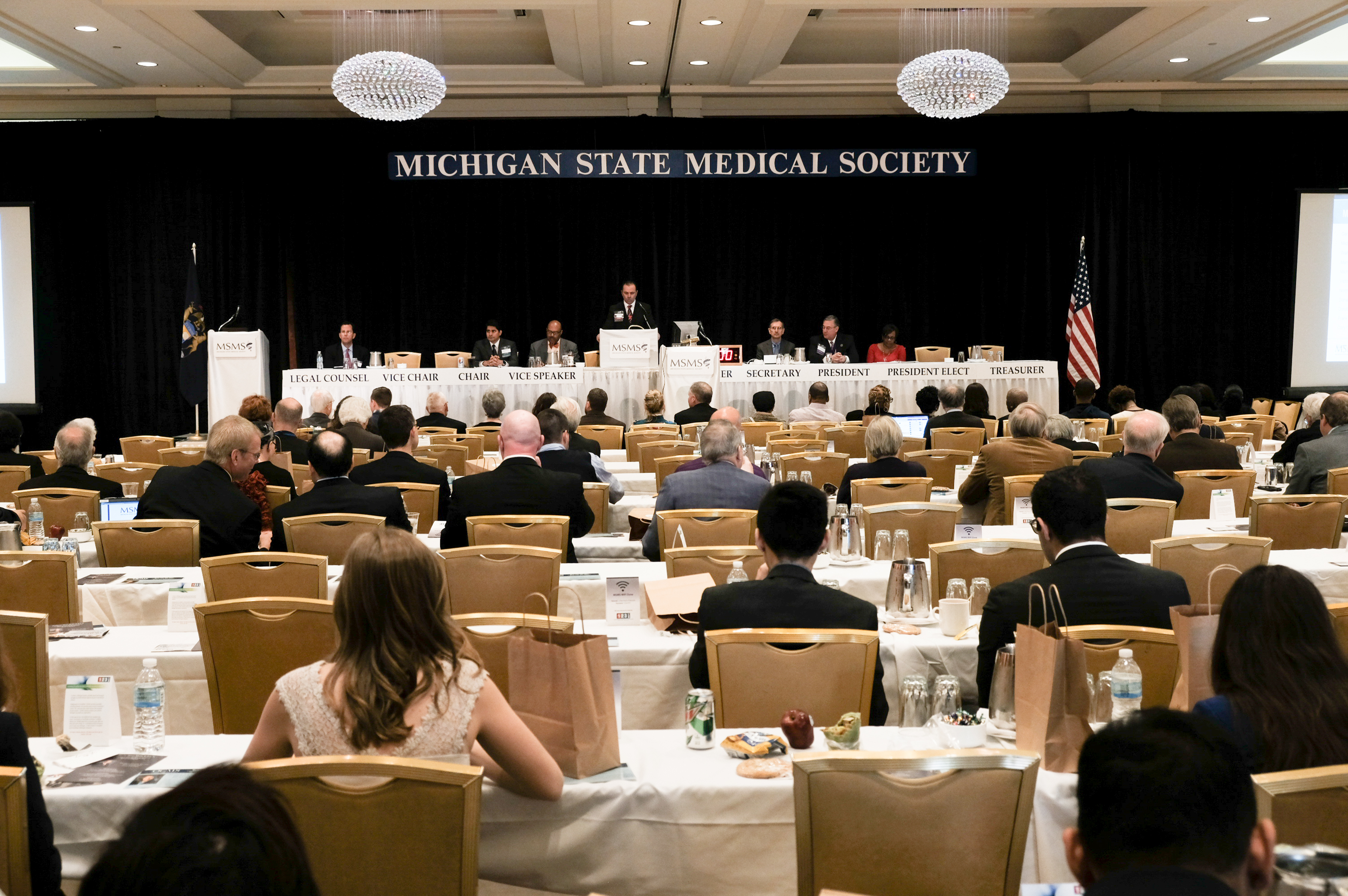
The House of Delegates is the official policy-making body of the Michigan State Medical Society. Resolutions and Board Action Reports are the primary tools used to debate and determine MSMS policies, priorities, and direction for the coming year and beyond. A well-crafted resolution is essential to effectively advocate for issues important to you.
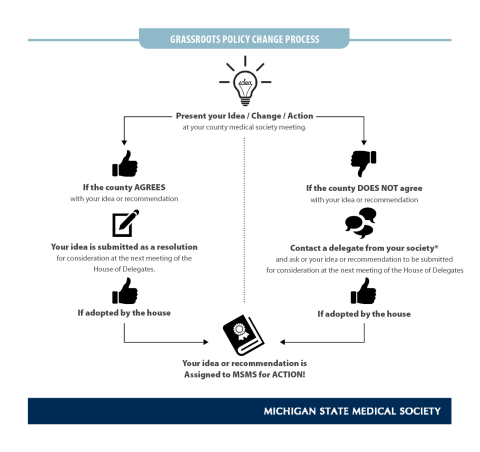
Resolutions may be submitted by voting delegates on behalf of their county delegation, specialty or ethnic medical society, MSMS membership section, or as individual delegates. To be considered regular business, resolutions must be submitted by 5:00 p.m. on March 1 (or the next business day if March 1 falls on a weekend). MSMS staff review all submissions for consistency with existing MSMS and AMA policy, legal considerations, and clarity before assigning numbers and referring them to one of six reference committees or placing them on the Reaffirmation Calendar.
Resolutions that reaffirm existing MSMS or AMA policy are placed on the Reaffirmation Calendar and voted on during Sunday’s session. Delegates may request extraction for committee review through the Committee on Rules and Order of Business, which meets Saturday morning.
Pursuant to HOD Resolution 65-14, any resolution requiring action by the AMA may only be submitted by MSMS members who are also AMA members.
Reference committees hear testimony, evaluate the merits of resolutions, and make recommendations to the House of Delegates on their final disposition.
The Process
Submitting a resolution to the House of Delegates has never been easier. Simply open the digital resolution form, complete the required fields, and click “Submit.”
Structure of a Resolution
Title
Select a title that is brief and accurately reflects the action for which the resolution calls.
Body
- Begin with the inclusion of one or more "whereas" statements.
- "Whereas" statements explain why the resolution is needed, provide documentation in support of the resolution (i.e., data, statistics, references), and contribute to the general understanding of the subject matter.
- "Whereas" statements lead into one or more "resolved" sections.
- "Resolved" sections define the "ask" or intent of the resolution (e.g., the author’s desired action).
- Because the House only adopts the "resolved" sections, each "resolved" section must be able to stand independent of the "whereas" statements.
- Example of an improperly written "resolved" statement, as the reader cannot readily identify the targeted issue(s), specific action requested, or to whom responsibility for acting upon the issue(s) is directed:
RESOLVED: That physicians need to know about the process and extent of diversion in the community and need to act as described above. - Example of a properly written "resolved" statement in which the issue and "ask" are clearly stated:
RESOLVED: That MSMS actively educate physicians about the process and extent of prescribed opiate medication diversion in the community and urge the health care providers prescribing daily opiates in chronic pain patients to monitor those patients at a minimum with yearly quantitative urine drug screens.
- Example of an improperly written "resolved" statement, as the reader cannot readily identify the targeted issue(s), specific action requested, or to whom responsibility for acting upon the issue(s) is directed:
Tips
- Paying particular attention to the following will enhance your chances of drafting a successful resolution:
- Ensure the accuracy of information presented in the resolution.
- Determine whether the topic of the resolution is existing MSMS and/or AMA policy prior to submission. MSMS and AMA policy can be found on their respective websites.
- If the Resolved statement is already existing policy, the resolution will be placed on the "Reaffirmation Calendar."
- If the Resolved statement is consistent with existing policy, specifically state the amendment you want to that policy.
- If the Resolved statement is not consistent with existing policy, indicate that you want to replace the existing policy.
- Ensure that the desired intent or "ask" is clear.
- Consider whether the requested action is feasible (i.e., is it relevant to medicine and to what the Michigan State Medical Society can reasonably affect).
- Determine whether there are cost implications to the proposed policy, program, or action and if so, select an estimated cost range.
- Contact your respective county society, specialty society, or sections to learn of their resolution vetting process should you wish for them to introduce the resolution on your behalf.
Late Resolutions
Resolutions received after the deadline, will be considered late resolutions and will be referred to the Committee on Rules and Order of Business.
If the Committee on Rules and Order of Business agrees to accept a late resolution, the resolution will be added to the Committee's agenda for review that evening. The final recommendation as to the resolution’s fate will be submitted to the House as part of the respective committee's report.
If the Committee on Rules and Order of Business does not accept a late resolution, a delegate may ask to have the resolution extracted from the Report of the Committee on Rules and Order of Business at the House of Delegates and present his or her arguments before the Committee of the Whole. If the House concurs with the Committee on Rules and Order of Business's recommendation to not accept the late resolution, there is no further recourse, and the resolution will not be considered.
Deadline
5:00 p.m. on March 1 (or the next business day if March 1 falls on a Saturday or Sunday)
Criteria
The Committee reviews any late resolutions on the following criteria:
- Could the resolution have been submitted before the deadline?
- Did new developments after the deadline justify the acceptance of the resolution?
- Were there any extenuating circumstances?
- Are there any other resolutions that cover the same logic?
Thank you for your interest in helping to establish the business of the MSMS House of Delegates. Please remember, only online resolutions will be accepted and they must be received by 5:00 p.m. on March 1 (or the next business day if March 1 falls on a Saturday or Sunday).